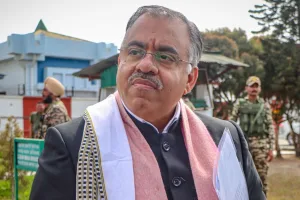
Did Hindu values lead to Gabbard’s resignation?
When I heard the name “Tulsi Gabbard” years ago I assumed that she was an Indian American, married to a Mr. Gabbard because Tulsi is a sacred plant to the Hindus.
People of all religious faiths admit that God is the Creator and controller of the universe, therefore He is Almighty.




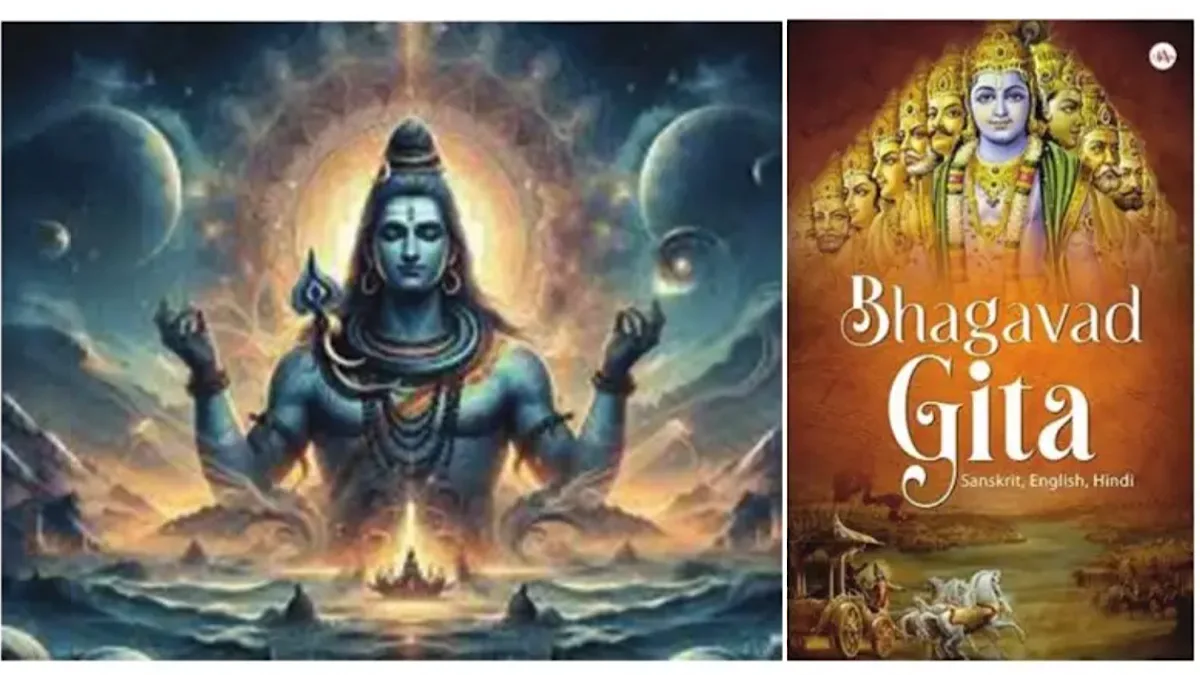
Photo:SNS
People of all religious faiths admit that God is the Creator and controller of the universe, therefore He is Almighty. Hindus worship Him as an omnipresent, omnipotent, and omniscient Being. He is Atman (Self), being subtler than the subtlest, and Brahman, being bigger than the biggest. He is thus unsurpassable, and in Him alone opposites (Dwanda) coexist side by side with no disputes. Hindus realized God as the Absolute all-inclusive Deity. He is, to them, the ultimate Reality.
Since all animate and inanimate things are made by Him, they are also real, but then, changeable and bound by His Law of Karma which is described by them, in another word, as Dharma. They say Dharma holds the universe and maintains it impeccably in a perfect order by means of reward and retribution in a process that is eternally functional in an inscrutable self-sustained sacrosanct manner, hence synonymous with God. Hindus believe that God is manifested in everything in varying degrees, in some less and in others more, but in man the most.
Advertisement
Yet, man suffers because he is ignorant and unaware of it. So, they take life as a spiritual journey to lead on the path walked by realized souls destined to the God within. Man is miserable because he forgets that he is God in reality, falsely believing himself a being with a name (Nama) and a form (Rupa) ~ including their adjuncts like birth, descent, faith, caste, country, etc. ~ which are, in fact, adventitious, and indeed have no bearing on his true nature. However, one of the most profound aspects they discovered about God was the truth that He is immanent as well as transcendent.
Advertisement
Concentrating on one’s own self, when one attains the state of Samadhi, one realizes God and knows for good that Self (Atman) and God (Brahman) are one and identical. One now perceives God within oneself and in everyone else simultaneously. Getting rid of the sense of separateness forever, one becomes liberated from all delusions of worldly discrimination and loves all unconditionally. One enjoys unity in diversity really and says sarvam-khalu-idam-Brahman (everything is full of Brahman), aham-Brahma-asmi (I am Brahman), and ayam-atma-Brahman (this self is Brahman).
One in this condition is called Brahma-Jnani (one who is knowledgeable about God), and Atma-Jnani (knowledgeable about the Self) as well. Such a person is recognized by them as Yoga-Yukta (established in yoga) and Samadarshi (one who sees all equally). He is, accordingly, established in the vision of sameness. The Gita corroborates this, saying: “With the heart concentrated by yoga, viewing all things with equal regard, he beholds himself in all beings and all beings in himself ” (6/29). Sri Krishna declares Himself as the Supreme Self in the Gita. He says the next verse: “He who sees Me everywhere, and sees everything in Me, to him I am never lost, nor is he ever lost to Me” (6/30).
Seers at the dawn of Hindu civilization had experienced this themselves spiritually and described its comprehensive egalitarian effect on them which is available in extant Vedic texts. They said in verse six of the Isa Upanishad: “He who sees all beings in himself and himself in all beings never hates anybody.” In the 8th century AD, the advent of Sankaracharya as a seer among the Hindus was a landmark phenomenon. He became legendary due to his unmatched applications, spiritual experiences, and expertise. Hinduism was then passing through a phase of decay and decadence.
He meticulously purged it of the evils and dross that had openly and surreptitiously crept into it for centuries. He reinstated it to its pristine purity rejuvenating the core content ~ “Atman alone abides” ~ of its message, and became an unparalleled spiritual path-finder to Hindus who were utterly confused and had got stuck in a blind alley. In order to revive and reorganize it, and propagate its immutable truths all over the country, he established four monasteries (Maths) in its four corners and gave their charge to his four most competent disciples. He wrote prolifically and interpreted Hinduism logically. He famously wrote commentaries on the Gita, ten principal Upanishads, Brahma Sutras and many Vedantic treatises in verses, besides a large number of Stotras.
In verse 254 of Viveka Chudamani, he says: “jati-niti-kula-gotra-duragam nama-rupa-guna-dosa-varjitam desa-kala-visayativarti yat brahma tat-tvam-asi bhavayatmani” God, who is far from caste, creed, family, and lineage; who excludes the defects of name and form and qualities; who transcends place, time, and sense objects; think yourself, Thou Art That. Sankaracharya saved Hindus from downfall and fortified Hinduism from self-destruction. Twelve hundred years later in the nineteenth century Hindus were again off their track and at a crossroads because of their exposure to Western material civilization and social discriminations giving a lie to the equality of humanity founded on the Truth.
That was a time which warranted the birth of another seer who could rein in the decline of Hindus by dint of his scientific approach for annihilating the palpable hatred and hostility planted in their minds in the name of Hinduism and its reformation shifting from its originality. Sri Ramakrishna was born. His advent marked an ostensible religious ferment; flamboyant leaders of diverse opinions and followings, who defected from traditional Hinduism, interacted with him impressively. He posed himself as a rustic before them, having no understanding of modernity, as it were. He was almost illiterate, possessing hardly any knowledge of the 3 Rs.
He was voluntarily walking on an unbeaten, lonely path, refusing all formal education, whether it was in vernacular or Sanskrit or English. He renounced material enjoyments altogether and swam against its high tide. He was born free and had un-groomed sterling qualities which charmed everyone who knew him. He was exceptionally intelligent and wise. He had a prodigious memory and tremendous amount of common sense. Above all, his love for God was so deep that he realized Him as the Mother of the Universe and Samadhi was his easy access. He said Mother taught him like Her child, therefore there was no need for him to learn from any human being. He was off and on in direct communication with God through it.
(The writer is associated with the Ramakrishna Mission Ashrama, Narendrapur)
Advertisement